Tire manufacturing is a complex industrial process that involves heavy machinery, high temperatures, moving materials, automated equipment, and numerous production stages. From rubber mixing and extrusion to component preparation, tire building, curing, inspection and testing, each operation presents potential hazards that must be carefully managed to protect employees and maintain a safe working environment.
The safety systems designed to protect the people operating and maintaining that equipment need to keep up with advanced tire manufacturing technology. Modern machinery manufacturers are expected to integrate safety into every stage of equipment design, installation, commissioning, operation, and maintenance.
However, safety extends beyond traditional machine guarding. Ergonomics, noise reduction, automated material handling, and the elimination of repetitive or hazardous manual tasks are equally important considerations.
Safety has been a fundamental part of Steelastic’s equipment portfolio for more than 55 years. Through its commitment to innovation, Steelastic continues to design and develop new systems and equipment specifically focused on improving safety, including its range of recently introduced SafeSplice cold feed extrusion splicing units, its range of hydraulic E-Dies, and its power-assisted loading and unloading systems for creels, cap strip spools, etc.
Understanding the Safety Hazards in Tire Manufacturing
A tire manufacturing plant contains numerous interconnected processes, each introducing its own safety considerations.
Employees routinely interact with rotating machinery, cutting systems, conveyors, extruders, and autonomously guided vehicles. Maintenance personnel must access equipment for routine maintenance, adjustments, and repairs, while operators frequently handle materials and perform repetitive production tasks such as tooling changes, stock loading and unloading, etc.
Some of the most significant hazards include:
- Moving Machinery: Rotating components, cutting equipment, conveyors, and other mechanical systems can create pinch points, entanglement hazards, and crushing risks.
- High Temperatures: Extrusion equipment, heated tooling, and tire curing presses expose personnel to hot surfaces and materials.
- Heavy Material Handling: Rubber sheets, reinforcement spools, and other production materials can require lifting, positioning, and repetitive operator movements.
- Noise Exposure: Cutting systems and other industrial machinery can generate significant noise during operation, causing potential hearing damage.
- Electrical Hazards: Control panels, drives, and other electrical equipment require appropriate protection against unauthorized access and accidental contact.
- Automated Material Movement: Autonomous guided vehicles and other automated transport systems move raw materials and finished components between production areas.
These risks demonstrate why safety can’t be treated as an isolated function. It must be incorporated into all aspects of equipment design, plant layout, operating procedures, employee training, and ongoing maintenance.
Designing Safety Into Tire Manufacturing Equipment
One of the most effective ways to reduce workplace hazards is to address them during the machinery design process.
Rather than relying exclusively on operators to avoid dangerous situations, equipment manufacturers can incorporate protective systems that restrict access to hazardous areas during operation or automatically stop machinery when unsafe conditions are detected.
Modern tire manufacturing equipment may incorporate several layers of protection.
Physical Machine Guarding
Physical guards create barriers between employees and hazardous moving components. These may include fixed enclosures, access doors, protective covers, and other structures that prevent accidental contact with machinery.
Where access is necessary for maintenance or adjustments, interlocked guarding can prevent hazardous operation while the protective barrier is open.
Light Curtains and Safety Scanners
Light curtains use photoelectric sensing to establish a protective field around machinery. When someone interrupts that field, the safety system initiates an appropriate protective response, such as stopping hazardous movement.
Area scanners can provide similar protection by monitoring designated spaces around equipment. These technologies are particularly useful where frequent operator access makes permanent physical barriers impractical.
Safety Mats
Pressure-sensitive safety mats detect when someone enters a protected area.
When activated, they can initiate a safety-related stop or prevent machinery from restarting until appropriate conditions are restored.
These systems’ selection and design depend on the equipment’s hazards and the applicable safety requirements.
It’s Steelastic’s responsibility as equipment manufacturers to make sure our equipment can be operated and maintained safely. This means considering safety throughout machine design, assembly, installation, commissioning, and for the lifetime of its use.
Meeting Machinery Safety Standards and Regulations
Industrial machinery must be designed and operated in accordance with applicable safety requirements.
Depending on the equipment and its location, these may include European CE-marking requirements, United States OSHA regulations, relevant ANSI B11 machinery safety standards, and applicable electrical safety standards.
These requirements influence numerous aspects of machine design, including guarding, emergency stopping functions, electrical protection, control systems, and safe access for maintenance.
However, regulatory compliance represents only one part of an effective safety strategy.
Machinery manufacturers must continually evaluate emerging technologies and opportunities to reduce hazards. Steelastic continues to improve its safety systems. This ongoing approach is particularly important as production lines become increasingly automated and equipment capabilities evolve.
Safety Is a Shared Responsibility
Although equipment manufacturers are responsible for designing and supplying machinery with appropriate safeguards, maintaining a safe production environment also requires commitment from the tire manufacturer.
Once machinery is installed, plant operators must ensure that equipment is used and maintained according to the manufacturer’s instructions.
This includes keeping protective guards in place, maintaining interlock systems, following approved maintenance procedures, and ensuring that personnel receive appropriate training.
Removing a guard, bypassing a safety device, or operating equipment outside its intended parameters can introduce significant risk.
Similarly, the tire manufacturer is responsible for broader plant safety considerations, including material transportation routes, interactions with autonomous vehicles, and coordination between different production systems.
With that in mind, a successful program depends on cooperation between equipment manufacturers, plant management, maintenance personnel, and machine operators.
Steelastic supports these efforts through its Maintenance & Operator Training Program, helping customers ensure equipment is operated and maintained according to manufacturer specifications.
Improving Tire Manufacturing Safety Through Equipment Innovation
Manufacturing safety isn’t a one-time engineering exercise.
New materials, production methods, automation technologies, and operating requirements continually introduce opportunities to improve how employees interact with equipment.
For Steelastic, continuous improvement means evaluating both established safety systems, and the manual tasks that remain part of tire manufacturing.
- Traditional protective measures, such as interlocked guards and safety sensors, help prevent access to hazardous machinery.
- Ergonomic solutions, such as assisted creel loading, reduce physical strain.
- Hydraulic E-Die technology automates demanding tooling operations.
- SafeSplice removes repetitive manual handling, splicing of heavy rubber sheets, and use of hot-knives.
Together, these technologies demonstrate an important progression in industrial safety: moving beyond protecting operators from hazards, toward redesigning processes to reduce or eliminate the hazards themselves.
Ergonomics: Addressing Injuries Beyond Moving Machinery
While machinery guarding is essential, not every workplace injury results from direct contact with moving equipment. Many industrial injuries develop through repetitive lifting, awkward positioning, excessive force, and prolonged physical strain.
In tire manufacturing, operators may repeatedly lift heavy streel and textile cord spools, manipulate rubber sheets, adjust tooling, or perform demanding maintenance tasks. These activities can contribute to musculoskeletal injuries involving the back, shoulder, arms, and wrists.
Ergonomics is another important aspect of equipment safety. At Steelastic, we need to make sure it’s as easy as possible for operators to do the often repetitive, day-to-day tasks that they need to get done.
Equipment manufacturers can address these concerns by incorporating mechanical assistance, automated functions, and more accessible machine designs. Steelastic has introduced several solutions that reduce the physical demands placed on operators while supporting more efficient production.
Assisted Creel Loading: Reducing Repetitive Lifting
Creels are used in tire component manufacturing to supply steel or textile reinforcement cords to downstream production equipment. Depending on the application, a creel may hold hundreds of spools. Loading and unloading these spools can become a physically demanding operation.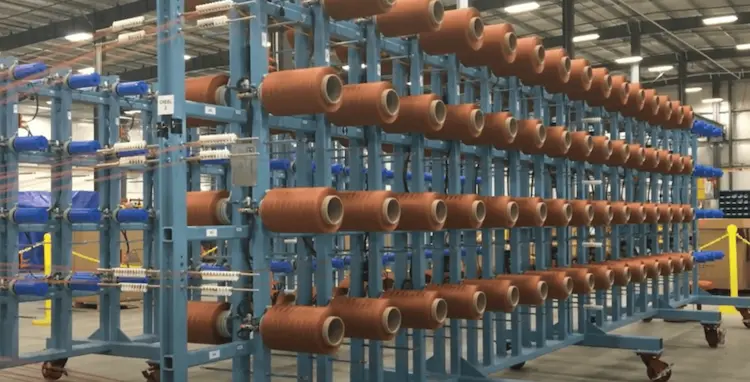
This is particularly difficult when operators need to position materials above shoulder height. A single steel reinforcement spool may weigh approximately 50 pounds, making repeated manual handling a potential ergonomic concern.
Consider an operator who’s required to load hundreds of spools during a production changeover. Without mechanical assistance, this process can involve repetitive lifting, reaching, and positioning heavy materials.
Steelastic addresses this challenge by providing assisted creel loading solutions.
These systems use pneumatic or winch-operated mechanisms to help operators position heavy spools without manually supporting their full weight. By reducing the lifting force required, assisted loading can help minimize physical strain and improve the ergonomics of routine material handling.
The objective is straightforward: allow employees to complete necessary production tasks while reducing unnecessary exposure to repetitive lifting hazards.
Hearing Protection: Noise Reduction and Operator Well-Being
Physical guarding and ergonomic improvements aren’t the only factors influencing workplace safety. Noise exposure is another important consideration in tire manufacturing. Cutting equipment, rotating machinery, and other production systems can generate significant sound levels. Prolonged exposure to excessive noise may contribute to hearing damage if appropriate controls aren’t implemented.
For equipment manufacturers, noise reduction should begin with machine design.
Steelastic considers noise generation in its belt and body ply cutting systems, where the cutting knife can be a particularly significant source of sound.
Potential measures include optimizing the cutting mechanism and incorporating protective enclosures or sound-reducing materials around noisy operations. Reducing noise at its source can complement facility-level hearing conservation measures and improve the overall working environment.
Steelastic’s Next Generation Steel Belt Systems incorporate design improvements that reduce operating noise by at least 10 dB, demonstrating how equipment innovation can help address noise exposure in tire manufacturing.
Hydraulic E-Die Technology: Eliminating Demanding Manual Tooling Operations
Another important safety consideration in tire component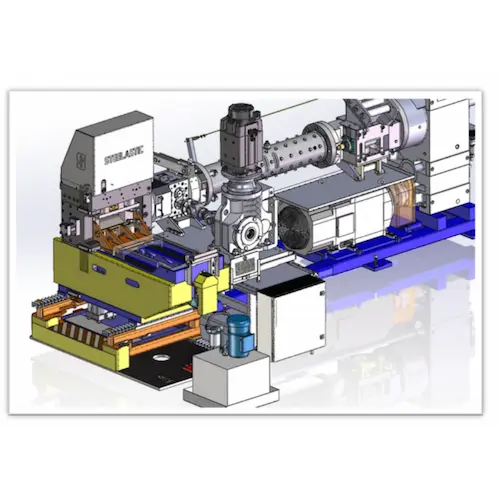 manufacturing involves opening and closing extrusion dies.
In Steelastic’s extrusion-based systems, the die coats steel or textile reinforcement cords with rubber. During operation, the die can reach temperatures of approximately 100°C. Traditional die opening and closing procedures require operators to use pneumatic tools to loosen and tighten multiple high-torque bolts.
On certain Steelastic systems, this process involves 13 bolts that must be released before the die can be opened for material or compound changes. Although pneumatic tools reduce the manual torque required, operators must still control the tool and manage the opening and closing procedure.
This can be physically demanding, particularly when performed repeatedly during production changeovers.
Steelastic’s Hydraulic E-Die technology was developed to automate this operation.
Instead of manually loosening and tightening the bolts, the system uses hydraulics to control die clamping and electrical servos to open and close the die.
At the touch of a button, the die automatically unclamps and opens. When the changeover is complete, the system closes and clamps the die without requiring the same manual bolting procedure.
This provides several important benefits:
- Reduces repetitive manual tooling operations
- Eliminates the need to manually operate high-torque bolting tools during routine die opening and closing
- Reduces physical demands on operators
- Simplifies changeover procedures
- Supports more consistent die clamping operations
- Improves the ergonomics of routine equipment operation
- Reduces changeover time significantly
The Hydraulic E-Die illustrates how automation can improve both safety and manufacturing efficiency by eliminating demanding manual tasks rather than simply making them easier.
SafeSplice: Automating One of Tire Manufacturing’s Most Hazardous Manual Tasks
Steelastic’s commitment to safety extends beyond the equipment it traditionally manufactures.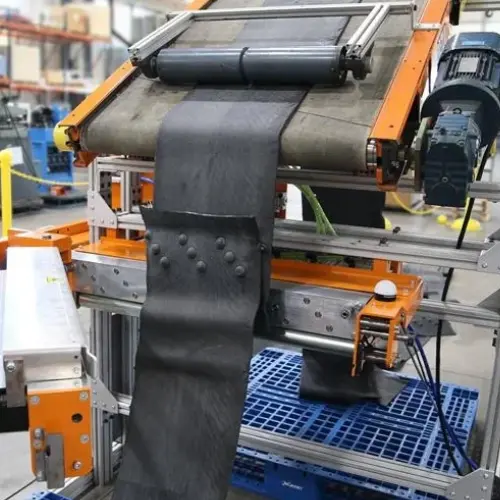
One example is SafeSplice, an automated cold feed extrusion splicing solution developed to address a common challenge in tire manufacturing extrusion operations. Large extrusion lines used to produce components such as tire treads, sidewalls, and inner liners require continuous supplies of rubber compound.
These materials may arrive in heavy sheets measuring up to 1,000 mm wide and up to 12mm thick.
When one rubber supply approaches its end, the operator traditionally must connect, or splice it, to the next sheet to maintain material flow. This operation is commonly performed using a manual fishtail splice, which may require an employee to lift and manipulate the heavy rubber sheets, cut the material with a heated knife, and manually join the two sheets.
Each step introduces potential hazards.
Heavy lifting and twisting can contribute to musculoskeletal injuries. The heated knife presents both cutting and burning risks. The operation also requires close interaction with the material feed system.
Steelastic developed SafeSplice to automate this process.
How SafeSplice Works
Rather than requiring the operator to manually cut and join rubber sheets, SafeSplice uses an automated splicing mechanism. The operator positions the next rubber sheet in the system and closes the loading gate. The equipment then monitors the material supply.
When the previous sheet reaches its end, SafeSplice automatically detects the transition and uses pneumatic mechanisms to join the materials. With this feature, the operator doesn’t need to be present when the splice occurs.
This approach eliminates the routine need for manual hot-knife splicing and reduces the physical handling associated with joining heavy rubber sheets.
Safety and Productivity Benefits
SafeSplice offers several potential advantages:
- Reduced Cutting Hazards: Eliminates routine manual hot-knife cutting during the splicing operation.
- Improved Ergonomics: Reduces heavy lifting, twisting, and manual manipulation of rubber sheets.
- Automated Operation: Performs the splice without requiring an operator at the joining point.
- Reduced Production Interruptions: Allows the next sheet to be prepared while the line continues operating.
- Consistent Splicing: Creates a controlled connection between successive rubber sheets.
- Broader Application Flexibility: Available in configurations for rubber sheets ranging from 400 mm to 1,000 mm wide.
Importantly, SafeSplice was developed primarily for larger tire manufacturing extrusion lines, including equipment beyond Steelastic’s traditional component preparation systems. This reflects a broader commitment to safety innovation: identifying hazardous operations throughout the tire manufacturing plant and developing technologies that can help eliminate them.
Building a Safer Future for Tire Manufacturing
Tire manufacturing will always involve complex equipment, demanding production processes, and significant industrial safety considerations. However, the way manufacturers manage those risks continues to evolve.
Modern safety strategies combine regulatory compliance, effective guarding, employee training, preventive maintenance, ergonomic design, and increasingly sophisticated automation.
For machinery manufacturers, the responsibility extends beyond delivering equipment that performs its intended production function. It also means considering how that equipment will be operated, maintained, and integrated into the working environment throughout its service life.
Steelastic continues to advance this philosophy through safety-focused equipment design and innovations that address some of the most demanding manual operations in tire manufacturing.
From automated die opening and assisted spool loading to the elimination of manual rubber splicing, these developments demonstrate how thoughtful engineering can contribute to safer, more efficient production.
Ultimately, improving safety in the tire manufacturing plant isn’t simply about meeting standards. It’s about protecting employees, reducing unnecessary exposure to hazards, and designing manufacturing processes that allow people and equipment to work together more safely.
By making safety a fundamental part of innovation, Steelastic is helping tire manufacturers build production environments that are both productive and safer for the people who make that productivity possible.