Uptime matters. Every tire manufacturer understands this concept.
Whether producing steel belt, textile reinforcement, apex, or other tire components, manufacturers rely on highly specialized equipment to operate with exceptional repeatability and precision. Even small deviations in machine setup, tooling condition, or process parameters can quickly lead to increased scrap, lower throughput, and costly downtime.
Many maintenance programs focus on repairing equipment after something fails. However, the most successful tire manufacturers recognize that maintaining production performance requires a more forward-thinking approach.
Regular OEM servicing is about far more than replacing worn parts or fixing broken equipment. It’s about protecting production, maintaining process accuracy, transferring knowledge to plant personnel, and identifying issues before they become expensive problems.
The goal of Steelastic’s Preventative Maintenance and Optimization Program (PMOP) is to assist the customer to optimize their preventative maintenance strategy for our equipment. Rather than a simple visit from maintenance, PMOP is a comprehensive evaluation of machine health, process performance, tooling condition, and operating practices designed to maximize long-term productivity and useful life.
OEM Service Is More Than Preventative Maintenance
A common misconception is that an OEM service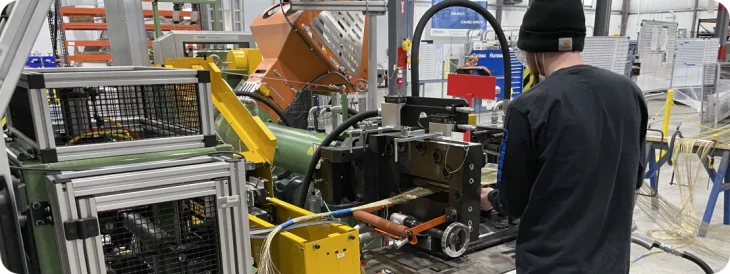 visit is simply a scheduled inspection.
In reality, Steelastic’s PMOP is a multifaceted evaluation performed by factory-trained specialists who understand both the equipment and the manufacturing process.
During a typical four- to five-day visit, often scheduled during planned shutdowns, the service engineer performs a complete health assessment of the equipment while evaluating how the machine is being operated.
They review the overall machine condition, which involves mechanical wear, process parameters, tooling condition, knife setup, and blade interference, along with preventative maintenance practices.
It’s not just about the maintenance of things, it’s also having an eye on the process parameters, how the machine is operating, and the condition of the tooling.
That broader perspective is one of the greatest advantages of working directly with the original equipment manufacturer.
Fresh Eyes Often Find Problems Others Can’t See
One of the greatest challenges in any manufacturing environment is that plant personnel become accustomed to seeing the same machine every day.
Small issues gradually become accepted as “normal.”
OEM service engineers bring an entirely different perspective.
Because they work across multiple plants and countless machine installations, they quickly recognize operating conditions that may seem ordinary to an in-house team, but in fact indicate developing problems.
Issues can range from incorrect knife setup and improper blade interference setting to misaligned components and worn tooling. These process parameters can extend outside recommended ranges, and common maintenance practices which as a result can increase wear on the parts.
Identifying these issues early prevents larger operational problems later.
Protecting Production Through Process Optimization
Modern tire component preparation equipment is designed to operate within precise mechanical and process tolerances. When those tolerances drift, even slightly, the effects often appear elsewhere in production.
During every PMOP visit, Steelastic engineers evaluate not only machine condition but also the customer’s production process.
They review operating speeds, tooling wear, die condition, and extrusion performance to ensure the equipment is producing material exactly as intended.
OEM servicing is designed to optimize how well the machine operates and avoid breakdowns through proper set up from a process perspective.
That distinction is important.
Repairing a machine restores operation. Reliably operating a machine improves production.
Knowledge Transfer Is More Valuable Than Ever
Today’s tire industry faces a challenge that didn’t 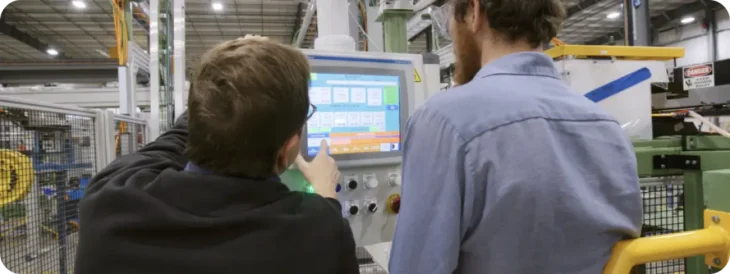 exist to the same degree a few decades ago: Employee turnover.
Twenty or thirty years ago, many employees spent their entire careers in one tire plant. However, that’s not the case anymore. High turnover means valuable equipment knowledge frequently leaves with experienced operators and maintenance personnel.
OEM service visits help replace that lost expertise. Regular PMOP visits provide continuous training for maintenance technicians, operators, process engineers, and tooling personnel.
We bring that knowledge with us. That alone is worth the visit for a lot of customers because they learn something that maybe they’ve been missing for a while.
Rather than simply servicing equipment, OEM specialists help rebuild institutional knowledge within the plant.
Why OEM Parts Matter Just as Much as OEM Service
OEM service and OEM spare parts are somewhat inseparable.
During a service visit, engineers frequently discover aftermarket or reverse-engineered components that appear acceptable but create significant production issues.
While something simple, like standard bearings, can often be sourced locally, specialized components, such as tooling, cutter assemblies, thrust washers, bushings, die parts, and precision assemblies require extremely tight manufacturing tolerances.
In the case of reverse-engineered parts, they may appear identical, but they likely differ in material selection, machining tolerances, surface finish, dimensional accuracy, and long-term durability.
Those differences affect machine movement, positioning accuracy, product quality, and equipment life.
Small Savings Can Create Very Large Costs
Cost-saving decisions are often evaluated too narrowly. Choosing a lower-cost replacement part may reduce some expense today.
However, the downstream consequences can be substantial.
Improperly manufactured replacement components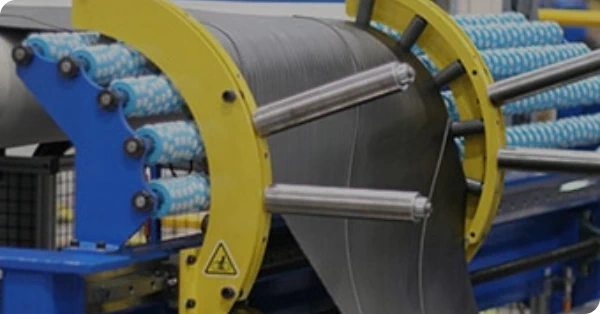 can introduce tolerance issues that restrict assembly movement or reduce positioning accuracy. In some cases, defects may not become apparent until significant product quantities have already been manufactured.
For example, one machine could be equipped with non-OEM die tooling that didn’t meet the right specifications. Because the tooling didn’t have the required dimensions, the equipment couldn’t properly coat steel cords at the right gauge, resulting in poor component quality that couldn’t pass inspection and never made it into the tire.
The consequences extend beyond product quality.
Because rejected material reduced available production capacity, the customer had to run the equipment longer, leaving less time for planned maintenance. Knife maintenance suffered, additional quality issues developed, and equipment performance continued to decline.
To put it simply, it’s a snowball rolling down the mountainside type issue.
Continuous Improvement Through Detailed Reporting
Every PMOP visit concludes with a comprehensive report documenting observations, recommended corrective actions, process improvements, and component replacement recommendations.
The report serves multiple purposes. It provides plant personnel with:
- A documented maintenance history
- Helps prioritize future repairs
- Allows Steelastic’s aftermarket team to follow up with recommendations and quotations for components identified during the visit.
Rather than being a one-time inspection, the PMOP becomes an ongoing roadmap for improving machine reliability and production performance for the life of the equipment.
A Strategic Investment in Productivity
Preventative maintenance should never be seen as simply a maintenance expense.
When performed by the original equipment manufacturer, regular service becomes an investment in productivity, quality, and long-term operational performance.
Steelastic’s PMOP combines preventative maintenance, process optimization, operator training, tooling evaluation, machine auditing, and ongoing technical support into a structured program tailored to each customer’s operation.
The program is designed to deliver measurable benefits, including:
- Reduced downtime
- Longer equipment life
- Predictable maintenance costs
- Documented service history
- Improved production reliability.
In addition, customers receive increasing discounts on OEM spare parts and service rates based on the frequency of PMOP visits, further reinforcing the value of a forward-thinking maintenance strategy.
In tire manufacturing, where repeatability, precision, and uptime directly affect profitability, regular OEM servicing is about much more than maintaining equipment.
It’s about maintaining production. And when production depends on machines operating exactly as designed, there’s no substitute for the expertise of the engineers who built them.
Contact us today to setup a consultation.