The calendering process has been at the center of the tire industry for decades, allowing manufacturers to produce reinforced tire components such as steel belt / breaker, steel body ply / carcass, and cap strip materials. In many tire plants worldwide, calendering is simply “the way it’s always been done.”
However, traditional calendering isn’t the only method available for producing high-quality tire reinforcement components. Nor is it the most appropriate in all manufacturing scenarios.
Steelastic pioneered an alternative approach more than fifty years ago: an extrusion-based tire component production process that coats steel or textile cords in rubber using a hot extrusion system rather than calendering and offline processing to produce belts, body plies and cap strip.
While both methods ultimately produce rubberized reinforcement materials for tire manufacturing, the processes are fundamentally different, and those differences impact quality, flexibility, operability and ultimately ROI.
This article will explore how Steelastic’s extrusion-based process work and examines the four key advantages that make the extrusion-based process both a compelling alternative to traditional calendering, and a process can work side by side with calendering.
Understand the Difference Between Calendering and Extrusion
To appreciate the benefits of extrusion-based manufacturing, it’s important to understand how the two processes differ.
In a conventional tire plant, a calender uses large rollers to press rubber onto steel or textile cords. The result is a wide sheet of reinforced material, that’s later transferred to offline cutting and splicing operations.
Steelastic’s process takes a fundamentally different approach. Instead of producing a wide sheet through a cold calendering operation, steel or textile cords are pulled from a creel, with precise tension control through a die head fed by a rubber extruder. The rubber is mixed and processed through the extruder, before entering a patented die that precisely coats the cords in rubber to an exacting gauge or thickness. The result is a finished reinforced strip, typically 10 inches wide, ready for downstream processing.
This difference in process architecture creates four distinct technical advantages.
Four Advantages of Extrusion-Based Tire Component Manufacturing
Advantage #1: Superior Extruded Gauge Control
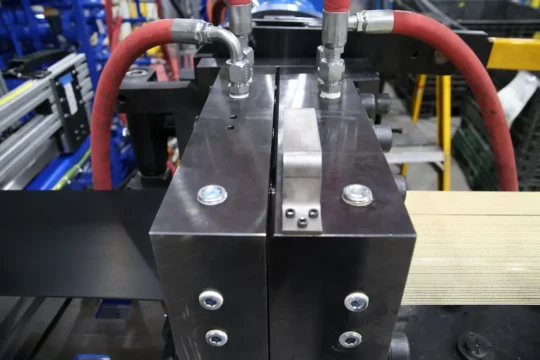
Extrusion Tire Manufacturing Die Head
The first and perhaps most significant advantage of the extrusion-based process is precise gauge control.
In tire reinforcement manufacturing, gauge refers to the thickness of the finished rubberized strip. Maintaining a consistent gauge is critical because variations can affect downstream processing, tire uniformity, and overall product quality.
Steelastic’s extrusion process can maintain thickness tolerances of +/- 0.05mm across the entire width of the strip.
This level of consistency is achieved through the design of the die and the die tooling. The throat section of the die tooling, along with precise pressure control throughout the extrusion process, establishes the final gauge of the material, ensuring that the finished strip exists at the exact thickness required by the customer. Whether the specification calls for 0.7mm, 1.0mm, or much thicker material, the tooling is engineered to produce that precise dimension.
The result is exceptional gauge uniformity across the strap, an area where extrusion-based systems can outperform traditional calendering methods.
For tire manufacturers, tighter gauge control translates into improved component consistency, reduced variation, and better overall process stability.
Advantage #2: Process Flexibility and Faster Changeovers
The second major advantage of extrusion-based manufacturing is superior flexibility.
The tire industry is rapidly evolving. Manufacturers are producing more tire variants than ever before, driven by changing vehicle designs, electrification, specialty applications, and customer demand for broader product portfolios.
There are more and more different tire types being produced, and this trend places increasing pressure on production systems to adapt quickly.
Traditional calendering and offline processing systems are large, complex machines. Changing from one cord type, or rubber compound, to another variation can take hours due to the size and complexity of the equipment.
The Steelastic extrusion-based process offers a much more agile alternative.
Because the system is more compact and modular, manufacturers can change both cord and rubber compound specifications in approximately 20 to 25 minutes.
This flexibility enables faster product transitions and reduced downtime with improved support for high-mix production environments. Additionally, this also leads to greater responsiveness to market demand, easier production scheduling, and more efficient utilization of manufacturing assets.
As tire portfolios continue to expand, this ability to adapt quickly becomes increasingly valuable.
Advantage #3: Precise Cord to Cord Positioning
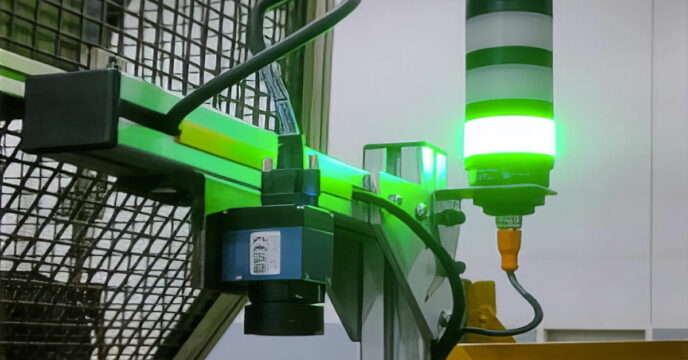
Steelastic CordSight Extrusion Thermal Inspection System
The third advantage lies in the way Steelastic controls cord positioning within the strip.
Inside the die is a precision tooling system component called an insert that contains an individual hole for every cord entering the process. Each steel or textile cord passes through its own dedicated opening before entering the rubber coating zone.
This design creates a fundamental advantage over calendering.
In a traditional calender process, the pressure of the rubber being forced onto the cords can sometimes cause cords to shift position. Variations in rubber flow across the calender’s width can move cords slightly, creating inconsistencies in cord spacing.
With Steelastic’s extrusion process, that movement can’t happen.
The spacing between cords is determined by the precisely machined hole locations within the insert tooling. This creates highly repeatable cord placement across the strip, improved reinforcement uniformity, and better downstream process control. For manufacturers focused on quality and repeatability, this level of positional accuracy represents a significant advantage.
Advantage #4: Superior Cord Positioning
The fourth advantage builds on precise cord to cord positioning and focuses on cord placement within the extruded strip itself.
Most tire manufacturers want reinforcement cords positioned exactly in the rubberized strip’s center. For example, if a strip is 1.0mm thick, the cord is precisely placed at the midpoint of that thickness. Alternatively, if required by the customer specifications, unbalanced top and bottom rubberization can also be achieved.
Maintaining this placement is critical because it influences the reinforcement effectiveness, material uniformity, component performance, and downstream consistency.
Steelastic’s tooling design enables extremely precise placement of each cord within the rubber profile. Because the cords are guided through dedicated tooling and coated under controlled conditions, their final position within the strip is maintained with exceptional accuracy.
Both cord-to-cord placement and positioning within the extruded strip are key benefits of the whole process. This capability contributes directly to improved component quality and process consistency.
A One-Stop Process from Creel to Finished Product
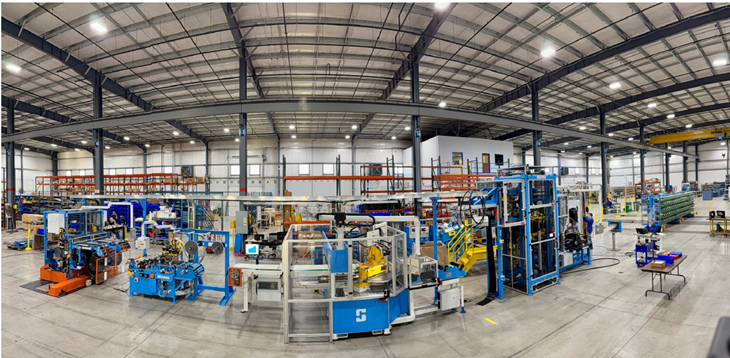
Steelastic Extrusion-Based Tire Manufacturing System
Another important characteristic of the Steelastic process is its integrated production philosophy.
The process begins with the creel, which provides constant tension to the steel or textile cords through pneumatic or electromechanical braking systems. As cord diameters decrease during unwinding, the braking system automatically adjusts to maintain consistent tension.
The cords then pass through the extrusion and die system, where they’re coated in rubber. Following extrusion, the strip enters a cooling drum accumulator that cools the material while maintaining controlled tension through the process. The cooling drum accumulator also provides the ability to accumulate extruded strip during short downstream process pauses, proving key operability benefits.
For belts and plies, cooled extruded strip is then processed downstream in precise cutting and splicing systems, with optional application of gum edging, before being wound up on cartridges or spools with liner to feed tire building machines.
For cap strip, cooling and accumulation systems are separated due to increased line speed, and are followed by highly automated winding under precise tension control, either with or without liner.
This integrated approach eliminates many of the intermediate handling steps associated with traditional calendering and offline processing operations.
Advanced Inspection and Quality Control
Modern Steelastic systems continue to evolve beyond the core extrusion process.
Today, systems incorporate advanced technologies, like hydraulic e-die systems, strip gauge inspection systems, thermal inspection systems that detect missing cords and defects, and automated process monitoring and quality verification tools with closed loop control.
These technologies complement the inherent advantages of extrusion-based manufacturing by providing additional layers of quality assurance and process control.
The Superior Steelastic Approach
The Steelastic extrusion-based process represents a fundamentally different approach to producing tire reinforcement components than traditional calendering and offline processing systems.
By replacing large cold calenders with an extrusion-based systems featuring a patented die design, manufacturers gain four significant advantages:
- Superior extruded gauge control
- Greater process flexibility and faster changeovers
- Precise cord positioning
- Improved cord-to-cord placement
Combined with integrated downstream processing, advanced quality control technologies, and more than fifty years of proven industry use, these advantages help explain why extrusion-based tire component manufacturing continues to gain attention from manufacturers seeking greater precision, flexibility, and efficiency in modern tire production.