The two- and three-wheel vehicle market includes an exceptionally  broad range of applications.
Commuter motorcycles, scooters, high-performance sport bikes, heavily loaded utility vehicles, dual-purpose motorcycles, and all-terrain vehicles, just to name a few, all place different demands on tire construction.
These differences affect the finished tire performance and how its reinforced components must be manufactured.
Understanding how reinforcement components are prepared is increasingly important as manufacturers manage broader product portfolios and more varied tire constructions.
Two primary architectures dominate this market: bias tire and radial tire construction. Each uses a differently arranged textile or steel reinforcement to create specific mechanical characteristics.
Bias tires remain important for moderate-speed, durable, and heavily loaded applications, while radial tires are increasingly used for higher-speed and performance-focused vehicles.
For tire manufacturers, the challenge isn’t simply choosing between the two. It’s having the production equipment capable of supporting the different reinforcement materials, widths, angles, and product variants associated with both constructions.
Understanding Bias Tire Construction
A bias tire uses multiple textile carcass plies arranged diagonally across the tire. The plies are layered in opposing directions, creating a cross-ply structure beneath the tread and through the sidewall.
Because these reinforcement plies extend diagonally from bead to bead, the crown and sidewall act as a more unified structure. The result is a relatively rigid tire that can perform well under heavy loading and in demanding road conditions.
Bias tires are frequently used for:
- Scooters and smaller motorcycles
- Moderate-speed applications
- Utility and heavily loaded vehicles
- Flexible vehicle chassis
- Rugged or inconsistent road surfaces
- High-volume, cost-sensitive production
The firmer sidewall construction can provide strong load-carrying capability and resistance to impact. This makes bias tires practical for markets where road quality, durability, and cost are more of a priority than extreme-speed performance.
Bias construction is particularly common in lower speed, rugged type road environments. However, the same unified crown and sidewall structure can be limiting at higher speeds. As speed increases, deformation in the tire profile may affect handling, heat generation, and contact behavior.
This is one of the primary reasons radial construction has become increasingly important in more powerful and performance-focused two-wheel applications.
Understanding Radial Tire Construction
A radial tire separates the sidewall’s mechanical behavior from the crown’s.
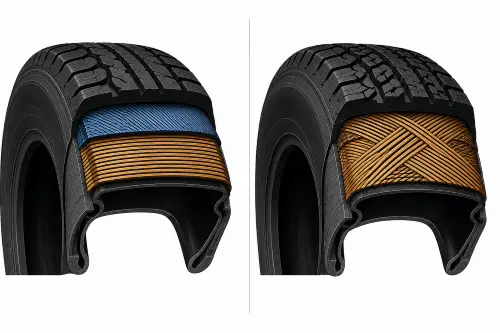
The carcass reinforcement cords are positioned radially, typically at approximately 90 degrees to the direction of travel. Additional reinforcement is then placed around the tire crown to form a belt or cap structure.
In a two-wheel radial tire, the crown reinforcement structure may include steel or textile belt reinforcement and cap strip with materials laid around the crown of the tire.
Unlike the opposing diagonal plies found in bias construction, the radial carcass is more flexibly independent due to the sidewall. The crown reinforcement then stabilizes the tread area.
This combination can provide several performance advantages:
- Greater stability at high speed
- More even pressure across the contact area
- More uniform tread wear
- Improved ride comfort
- A wider contact footprint during cornering
- Better grip at sharper lean angles
The radial structure is necessary for more powerful vehicles with an extremely rigid chassis as well as those used for sport. For manufacturers serving performance motorcycle, premium scooter, or high-speed markets, radial tire production is therefore becoming increasingly important.
Radial Tires vs. Bias Tires: A Technical Comparison
| Characteristic | Bias Tire Construction | Radial Tire Construction |
|---|---|---|
| Carcass Construction | Multiple textile plies laid diagonally across one another in alternating directions | Textile body plies run radially with additional belt or cap reinforcement beneath the tread |
| Ideal Uses | Ideal for heavy-duty and off-the-road uses | Ideal for high-speed driving and everyday road uses |
| Riding Style | Smoother and more comfortable ride | Slightly firmer ride |
| Traction | Good traction and grip in off-road and rough terrain situations | Traction and grip in both wet and dry conditions |
| Rolling Resistance | Higher rolling resistance | Lower rolling resistance |
| Manufacturing Costs | Less expensive to manufacture | More expensive to manufacture |
| Heat Generation | Produces more heat when in use | Generates less heat during operation due to flexible sidewalls and reduced internal friction |
| Load Carrying Capacity | Excellent for heavy loads and rugged operating environments | Excellent load performance while maintaining stability at higher operating speeds |
| Typical Applications | Scooters, commuter motorcycles, utility motorcycles, agricultural equipment, developing market applications, and rugged terrain | High-performance motorcycles, sport bikes, premium scooters, touring motorcycles, and performance-oriented vehicles |
| Wear Characteristics | Can experience less uniform tread wear because of changing contact pressure | More even pressure distribution promotes uniform tread wear and longer service life |
Radial Tires vs. Bias Tires: Where’s the Advantage?
| Advantage | Bias Ply | Radial Ply | Why? |
|---|---|---|---|
| Load-Carrying Capacity | ✓ | × | In bias tires, the uniform number of multiple plies supports the vehicle’s weight in both the tread face and sidewall. |
| Speed/Heat Dissipation | × | ✓ | With their flexible sidewalls and reduced internal friction, radial tires generate less heat during operation. |
| Puncture Resistance | ✓ | × | In rough-terrain situations, bias ply tires’ reinforced sidewalls provide stronger protection. |
| Torque Splitting | ✓ | × | Punctures in bias ply tires are less likely to expand under pressure, making them easier to repair. |
| Pavement Manners | × | ✓ | Radial tires are the better choice for everyday on-pavement ride and handling situations. |
| Performance Handling | × | ✓ | Radial tires can handle abrupt corners, sweeping turns, and other performance maneuvers. |
| Traction | ✓ | ✓ | Radial tires offer greater flexibility and terrain conformity, while bias ply tires trade flexibility for stronger sidewalls and puncture resistance. |
The Manufacturing Difference Is in the Reinforcement
From a tire component manufacturing perspective, the central difference between bias and radial production lies in the reinforced layers’ orientation, material, and configuration.
Bias tires commonly rely heavily on textile reinforcement arranged at opposing angles. Radial tires typically use a radial textile body ply to form the carcass, with additional steel or textile reinforcement around the crown.
However, tire designs vary significantly. Even within one architecture, manufacturers may use different
- Textile materials
- Cord counts
- Component widths
- Cutting angles
- Gauges
- Belt construction
- Cap strip configurations
- Number of reinforcement plies
Therefore, the key manufacturing requirement is flexibility. A component preparation system must be capable of processing the specific reinforcement construction required by each tire design without creating excessive downtime, scrap or capital complexity.
Why Flexibility Matters in the Two- and Three-Wheel Market
Historically, many two- and three-wheel tire markets were dominated by large production volumes and relatively limited SKU variation. That environment often suited conventional calendering and offline processing methods.
Today, the market is changing.
Exactly what’s happened in the passenger car market is happening in the motorcycle market, where the variation in the types of tires is huge and significantly growing.
Manufacturers increasingly need to produce bias, radial, scooter, utility, dual-purpose, and all-terrain in multiple sizes and specifications.
The constructions have changed, the speed requirements have changed, and the demands are increasing. This expanding product mix makes long, dedicated production runs less practical. Manufacturers need manufacturing systems that can change between materials, widths, and component specifications efficiently.
These requirements are particularly important in two- and three-wheel tire manufacturing, where equipment may need to support a broad mix of tire constructions and component specifications.
Producing Multiple Reinforcement Components on One Platform
One of the strongest advantages to equipment like Steelastic’s for two- and three-wheel tire production is the ability to manufacture multiple component types using the same system architecture.
Depending on the machine configuration, manufacturers can produce: steel belt, textile belt, textile body ply, steel cap strip, textile cap strip, and chafer and other reinforcement strips.
The downstream cutting angle can be adjusted across a broad range, allowing one system to support radial body ply material, as well as angled belt or bias-ply components. This reduces the need for separate dedicated lines and gives manufacturers a practical way to expand their product portfolios without duplicating major capital equipment.
Extrusion-Based Advantages for Steel and Textile Components
Steelastic uses an extrusion-based tire component manufacturing process, which delivers numerous advantages to the production process.
Precise Cord Placement: Each cord can be accurately positioned within the reinforced strip, supporting consistent spacing and component geometry.
Full Cord Encapsulation: The extrusion process surrounds the reinforcement cords with rubber, providing full encapsulation. This can be especially valuable for textile materials used in humid production or service environments.
Reduced Risk of Cord Damage: Traditional slitting processes can potentially expose or cut cords at the edge of a component. Steelastic’s process produces the required component width directly, helping avoid this issue.
Integrated Manufacturing: The system provides a one-stop process from creel to windup, reducing the need to produce large calendered rolls and transfer them to separate offline processing equipment.
Flexible Changeovers: The equipment can transition between specifications more efficiently than large conventional systems, supporting high-SKU production.
A Scalable Approach to Market Growth
Steelastic systems can also support incremental capacity expansion.
A manufacturer may begin with a single system and add additional equipment as demand grows. Multiple systems can then produce different SKUs simultaneously, creating a modular production strategy rather than requiring one large, fixed line.
They can buy a single system, then add to that and add another system, and they can produce multiple SKUs at once. This approach can lower initial capital exposure, speed up payback time, and give manufacturers a clear path to incrementally expand production.
One Technology Platform for Bias and Radial Production
The most important takeaway isn’t that bias and radial tires are interchangeable. They’re not. Each architecture has different performance characteristics, construction methods, and market applications.
The important point is that Steelastic understands those differences and has equipment capable of supporting both.
Whether a manufacturer needs angled textile ply for a rugged bias tire, radial body ply for a high-performance motorcycle tire, steel belt, textile belt, or cap strip reinforcement, Steelastic can configure its tire component production systems to produce the required component.
Preparing for a More Diverse Tire Market
The two- and three-wheel tire market is moving toward greater product variety, changing speed requirements, and more specialized constructions. Manufacturers that previously relied on a small number of high-volume bias products may increasingly need to add radial designs, premium products, or additional SKUs.
That shift favors equipment that is precise, scalable, and flexible.
Steelastic’s extrusion-based systems offer a lower-footprint alternative to traditional calendaring and offline processing while providing the versatility required to manufacture steel and textile reinforcement components for both bias and radial architectures.
For manufacturers evaluating a flexible approach to two- and three-wheel tire component preparation, the message is clear:
Steelastic’s machinery isn’t limited to passenger car, truck, or off-the-road tire production. It’s equally suited to the growing, high-mix world of bias and radial motorcycle, scooter, and three-wheel tire manufacturing.
Contact Steelastic today to learn more about our extrusion-based tire manufacturing process.