The global tire industry is expanding into a new era of manufacturing. Demand patterns are changing, product portfolios are expanding, and manufacturers are under increasing pressure to deliver higher quality while maintaining efficiency and agility. At the same time, electrification, autonomous vehicles, and sustainable materials are reshaping how tires are designed and produced.
To stay competitive, tire manufacturers must rethink how their factories operate. Traditional large-batch production models are giving way to more flexible, digitally integrated manufacturing environments capable of responding quickly to market shifts.
Steelastic is one of the forward-thinking manufacturers that is helping lead this transformation through innovations such as extrusion-based tire component production technology and modular equipment design. These two approaches are redefining how reinforced tire components are manufactured.
Understanding the trends driving this shift provides insight into where tire manufacturing is headed, and how producers can position themselves for the future.
The Shift Toward Flexible Manufacturing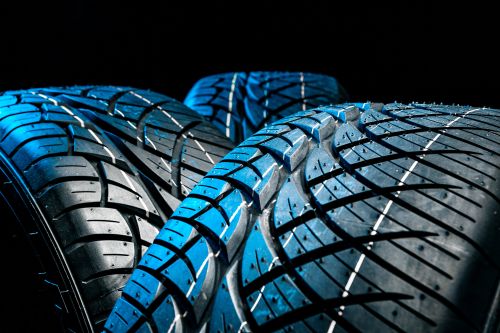
One of the most significant trends in tire manufacturing is the drive for greater production flexibility. Tire manufacturers today must support a much wider variety of products than ever before, with huge increases in tire stock. Manufacturers are keeping units (SKUs) across passenger car, truck, bus and off the road tire applications – all of which require distinct tire constructions.
At the same time, customer expectations are shifting toward faster delivery and more customized product offerings.
Historically, tire plants were designed around high-volume production runs of relatively few SKUs. Large calendering lines and batch-oriented processes were optimized for efficiency at scale, but often lacked the agility needed to quickly transition between different product types.
Today’s market requires a different approach. Manufacturers increasingly prioritize faster changeovers, smaller production campaigns, reduced work in-progress inventory, and more responsive production planning.
Extrusion-based tire component manufacturing technology directly supports this trend by enabling continuous, integrated production lines that can adapt more quickly to changing requirements.
Extrusion Based Technology: Simplifying Production
Extrusion based manufacturing represents one of the most important innovations in reinforced tire component production.
In traditional tire manufacturing environments, calendering machines use large rollers to embed reinforcement materials, such as steel cords or textile cords, into wide rubber sheets. These sheets are then wound into rolls, transported, and processed on separate cutting and splicing equipment before entering the tire building process.
While effective, this workflow introduces multiple handoffs and requires significant floor space, infrastructure and capital outlay.
Extrusion-based technology replaces much of this process with a process line that runs from the steel or textile creel, to finished components in one continuous process.
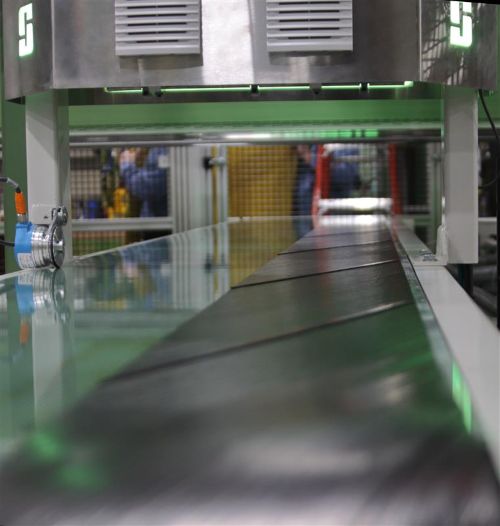
Instead of producing large sheets of reinforced rubber that must be handled and stored, extrusion-based systems combine the key production steps into one streamlined process that can produce steel belts, steel or textile body plies, and steel or textile cap strips with improved efficiency and quality.
This approach reduces operational complexity, while offering improved control over material
placement and component dimensions.
Reducing Work-In-Progress and Material Handling
Another important trend shaping tire manufacturing is the push to reduce work-in-progress inventory.
Traditional calender-based production often generates large volumes of intermediate
material that must be stored and transported between different processing stages, often in temperature and humidity-controlled environments. These materials occupy valuable floor space and introduce additional labor and logistics requirements.
Extrusion-based systems address this challenge by producing components within one continuous workflow. By reducing the number of processing stages, manufacturers can significantly reduce internal materials movement and simplify plant operations.
This streamlined approach improves traceability and enables faster response to production changes or quality adjustments.
Modular Design: Building the Factory of the Future
Alongside extrusion-based technology, modular equipment design is emerging as a key enabler of next-generation tire plants.
Traditional tire manufacturing lines are often large installations that require extensive infrastructure investment and long installation timelines. Expanding capacity or adapting to new products can require significant facility modifications and capital outlay.
Modular manufacturing systems offer a different model.
By designing production equipment as configurable modules, manufacturers can add capacity incrementally, reconfigure production lines more easily, reduce installation complexity, and support evolving product portfolios.
This flexibility is particularly valuable in an environment where market demand can shift rapidly and product innovation cycles continue to accelerate.
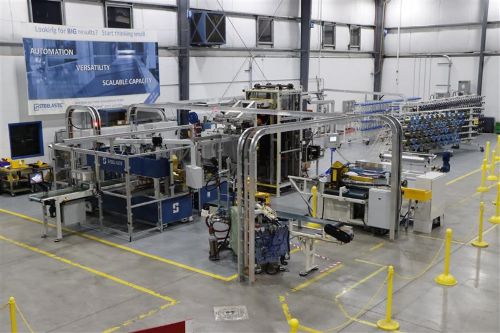
Modular design also supports phased capital investment, allowing manufacturers to scale production without committing to massive upfront infrastructure projects.
Quality and Precision Through Process Control
As tire designs become more sophisticated, it is increasingly important to maintain uniform quality throughout production. Modern tires use intricate reinforcement patterns and thin materials that demand highly accurate manufacturing techniques. Small differences in thickness, alignment, or placement of materials can affect how well a tire performs.
Extrusion-based manufacturing improves control over these details by combining reinforcement placement, extrusion, cutting, splicing, gum edging and component wind-up into one streamlined process. This allows manufacturers to achieve greater consistency in their reinforced tire components.
With advanced control systems and automated monitoring, precision is further increased, ensuring that each part of the process matches exact specifications.
Sustainability and Resource Efficiency
Sustainability has become another major driver of innovation in tire manufacturing.
Manufacturers are seeking ways to reduce energy consumption, material waste, plant footprint, and environmental impact.
Extrusion-based technology contributes to these goals by simplifying production workflows and reducing scrap. By producing components in a more controlled and efficient manner, manufacturers can minimize material waste while improving overall process efficiency and quality.
Smaller equipment footprints and reduced material handling also support more efficient factory layouts, which can further improve energy utilization and operational sustainability.
Preparing for the Next Generation of Tires
Emerging vehicle technologies are also influencing how tires are designed and manufactured.
Electric vehicles, for example, impose new performance requirements on tires. Increased torque, heavier battery loads, and the need for lower rolling resistance are driving new tire designs and construction methods.
These evolving requirements place additional pressure on manufacturing systems to maintain precision while accommodating new reinforcement structures and materials.
Flexible manufacturing technologies, including extrusion-based production and modular equipment architectures, allow tire manufacturers to adapt more quickly as these new tire designs enter the market.
Innovation Through Collaboration
As manufacturing technology continues to evolve, collaboration between equipment suppliers and tire manufacturers is becoming increasingly important.
Developing new production methods often requires close cooperation between engineering teams to ensure equipment design aligns with material properties, tire construction methods, and plant operating conditions.
Steelastic supports this collaborative approach through advanced engineering capabilities and dedicated manufacturing cells where customers can test new materials and processes, build and fully test tires in their own factories, before full-scale production deployment.
By combining equipment innovation with real-world process expertise, manufacturers can accelerate the adoption of new technologies while minimizing risk.
Looking Ahead
The tire industry is experiencing a period of rapid transformation. Growing product complexity, shifting market demands, and evolving vehicle technologies are reshaping how tires are designed and produced.
Manufacturers that embrace flexible production models, streamlined workflows, and advanced manufacturing technologies will be better positioned to respond to these changes.
Extrusion-based technology and modular equipment design represent powerful tools in this transition, helping manufacturers. Simplify production, improve quality, and remain agile in an increasingly dynamic market.
As innovation continues to accelerate, forward-thinking companies will not simply adapt to change. They will lead it.
Steelastic remains committed to helping tire manufacturers navigate this future through engineering innovation, advanced manufacturing technologies, and collaborative problem-solving that drives the next generation of tire production.